
Rioconn Interactive Pvt. Ltd.

Blogs

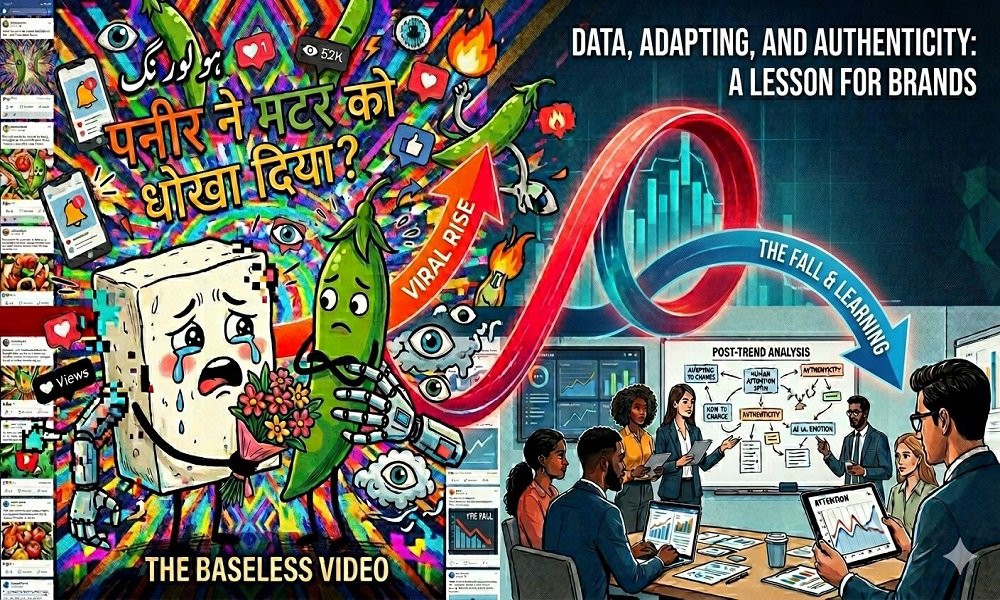
“Paneer, tum mujhe kabhi dhokha nahi doge na?”

Doesn’t this line sound familiar? This was one VIRAL TREND that was everywhere on social media. Views kept multiplying into hundreds and then thousands. Even brands started noticing how such baseless content was dominating audience attention online.

Despite despising such content, millions of people ended up watching them anyway. They also ended up getting thousands of shares, millions of views, and saves.

And suddenly, our feeds’ algorithms were full of emotional fruits and vegetables, out-of-tune dubbed AI voices, and whatnot!!

Understanding Viral Trends

This clearly conveys one thing: creativity has now reached new heights. People and technology are getting way too flexible when it comes to expression. Critics of such videos ended up recreating them for entertainment and engagement purposes.

This is exactly what makes this or any “trend” interesting. Today, social media is all about likes and fame. It is not about talent. If a cringe-worthy content clicks, it clicks… For all we know, today it is not just about adding a pinch of traditional essence of advertising and promotion. It is all about unpredictability. 

This is why it is important to realize that creators understand their audience’s mood, which is somewhat lacking in the business world. It is not just about displaying affection, but about causing a stir.

For years, brands have just been focusing on making their projects look polished and perfect. Be it lighting, props, scripts, or marketing, everything has to be perfect! This pool of flawlessness is what led to the gradual decline in the way someone perceives a brand. It is also a reason why a brand’s content gets more and more predictable with time.

To challenge predictability, AI took over.

Initially, content created using AI felt strange and confusing. But with time, people got comfortable using it for content creation. What usually takes hours or even weeks to shoot and edit can now be done in minutes. And yes, even animated edits.

With faster turnaround time, daily posting became easier. Which also made such content harder to ignore. This is exactly how social media marketing is evolving in 2026. AI is not just changing how content is created, it is also about what people’s watching preferences are.

Despite all these changing trends, some brands still follow the same old social media strategies. Audiences today are so used to consuming fast, dramatic, and exaggerated content that playing safe doesn’t work. Same old corporate posts and predictable content flow are why some brands are struggling to grow online.

Adapting to old methods in today’s advertising world is like trying to win an F1 race in a horse cart. Brands have to understand their audience’s behaviour and adapt accordingly. Because on the internet, attention is everything.

What Can Brands Learn From AI-Driven Content?

There are some things that brands today should learn from their competitors, which in this context is Artificial Intelligence. They should know how to be different as an advertising agency, in terms of ideation, sounding human enough to convey the brand’s message, etc. Though one major thing agencies must focus on is realizing when to stop sounding like one.

Now, this doesn’t mean that these brain-rot trends should be followed blindly for traction. The core reason being that the trends showing “paneer versus matar”, “kadhi versus rice”, and much more died down no sooner than they arrived! Though these brain-rot video creators got what they wanted -views, engagement, and recognition. Because they know people want more than just content.

However, though content creation has become easier with A.I., grabbing attention has become difficult. And in this era of technological growth, where generating content in seconds has become easier, it has also become easier to differentiate between interesting and dull ways of storytelling.

The lessons that brands need to learn from this well-performing content are many. But mostly, the shared content must be casual, slightly imperfect, and emotionally real. Do you remember the 2019 Surf Excel “Rang Laaye Sang” Holi ad? These kinds of ads are known for being culturally aware and showcasing religious harmony.

The internet is a place where people connect with content that is raw and organic, and prefer authenticity over extremely polished content. And trends just come and go, just like the “Paneer Ne Matar Ko Dhokha Diya” trend. Also, the thing about modern marketing is that people don’t forget content that makes them feel something. Even if it is confusing, people on the internet prefer unpredictable storytelling. This is something every marketing agency should understand while planning campaigns.

And honestly, this tells us a lot about the current state of social media.

  • AI can generate visuals.
  • AI can generate captions.
  • AI can even generate stories.

But understanding human attention?

That still takes a human mind.
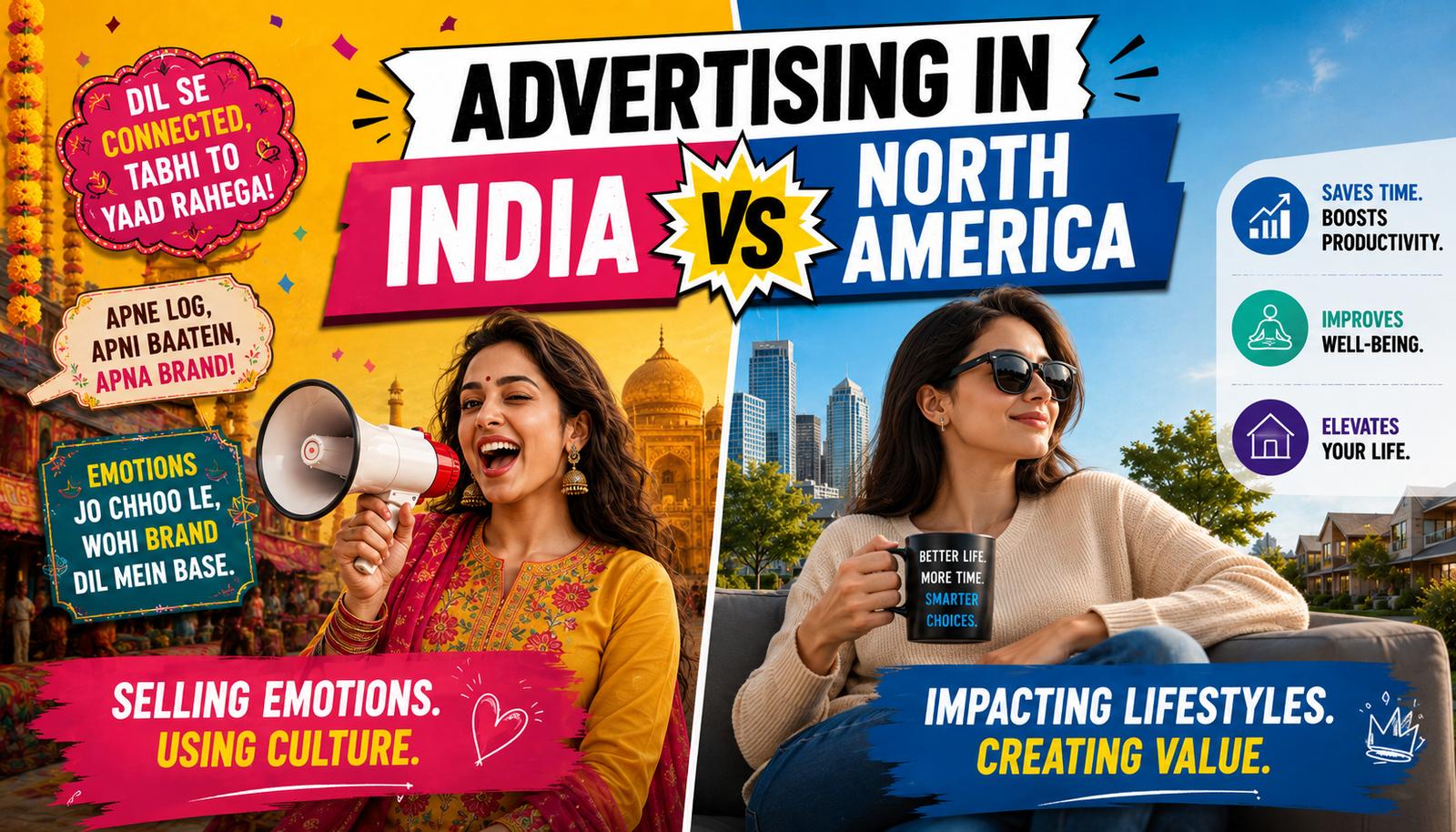
In a world where advertising as a concept (and budget) is rising, it has not been concluded which tonality sells which product. And this is just one of the many comparisons.

While Indian advertising is busy concentrating on family values, emotional storytelling, and high-context cultural referencing, North American digital marketing agencies have been busy doing the real job: selling the product. They have a direct approach when advertising. Portraying a want as a need and selling it at once is what they focus on. This makes them people who really stick to the point, along with the ‘No BS’ market. I mean, when advertising came about, wasn’t this the whole point? Sell products or services to cater to people’s needs? However, Indian advertising has gone for a toss, where, to sell one product (or service), we need to study the psyche of an entire family. I mean, really? We are talking about generations living in the same house. How can I sell a laptop to a grandma who is 80? I just cannot, or at least that’s what I think. North America, on the other hand, focuses on individuals, their achievements, what drives them, what forces them to take action, and what kind of lifestyle they aspire to have. It becomes relatively easy to position one’s brand by decoding the probable psyche while also ensuring adequate brand awareness and sales. Indian advertisers and brands are now attempting to enter the ‘address the social stigma, set a great narrative, and position the brand as a good brand’ cycle, which is miserably failing for them. There is one of two reasons behind it. Either because they position themselves as a sustainable brand for the narrative’s sake (the classic Britania’s environment day OOH) and get a backlash, or because they think that this is all the consumers care for. In reality, any social stigma is much more layered than that. A brand strictly needs to follow through on the narrative they put forth. When a North American brand releases a campaign that covers the insight of inclusivity and diversity, they actually mean it (at least most of them do). They ensure hiring and supporting people of all colours, genders, sizes, shapes, and religions. Indian advertising, in hindsight, miserably fails at this (as Indians, we all know how). While the new generation is trying hard to push their peers to think differently, North America already excels at this, as it is an immigrant-first country. This gives them a much deeper understanding of the globe and people’s mindset.

India is a huge country, with a population of 140 crore, stemming from different parts of the country. We all have different dialects, languages and norms. If advertisers wanted, they could also capitalise on this idea of ‘inclusivity and diversity, ’ provided they genuinely followed through. Now, let’s compare how an Indian and a North American brand advertise for a global brand. For instance, take McDonald’s. A recent campaign covered how McDonald’s is offering bicycle drive-thrus. In this campaign, they very smartly show how a customer is going to hold the takeaway bag (holding it with their teeth). This is proof enough of how effective, simple, yet interesting a campaign can be. Indian McDonald’s brand, however, is running a campaign called ‘Khaao Baant Ke’ where a young couple (kids) are shown discussing how boys today are acting like princesses. Let’s not even get to the forceful integration of McDonald’s. I could totally insert an automobile brand and remake the same ad. It did not strike my emotions at all for one. This is almost like holding your nose by holding your hand around your neck entirely. And honestly, do we need that? This is me talking openly about how I feel about a few (too many) Indian campaigns. It is about time we get a bit practical and really focus on driving sales and not just the narrative (for the record, I love advertising, and this is my way of giving constructive feedback because I have been a part of the North American advertising space).

Anyway, if you love advertising too, want your brand to flourish, and are looking for a digital marketing agency or a digital marketing agency in Ahmedabad, to be precise, that can balance both the narrative and sales, reach out to us at https://rioconn.tech/.

We have all grown up watching panel shows like Indian Idol, Koffee with Karan, and Dance India Dance. And for you oldies….I am assuming shows like Boogie Woogie, Jeena Isi Ka Naam Hai were classics (I don’t know man, I am not that old. Let me talk to my Team Lead and get back to you).

If you are one of those people wondering what a panel show even is, don’t worry, you don’t have to go ask ChatGPT. Let me help. A panel show is a kind of game show where either celebrities participate to win or facilitate play by non-celebrity contestants and judge them based on their skills.

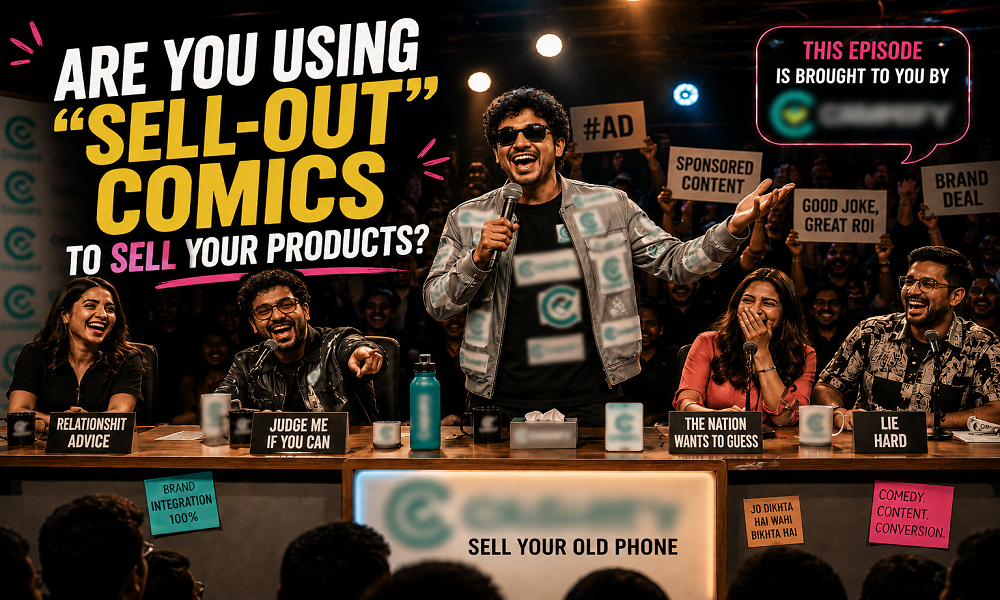
Now, there is a surge of new a format of panel shows. Not the ones that are broadcasted on TV every weekend, but the ones posted on YouTube by comedians. These panel shows are everywhere. From Raunaq Rajani’s Relationshit Advice (they do give shitty advice, please never take it) to Ashish Solanki’s Judge Me If You Can (personally, it’s really hard not to judge), every comedian is bringing their own version of a panel show on YouTube. Their popularity is fueled by the Indian audiences’ love for them, on and off stage. Shows like Gursimran Khamba’s The Nation Wants to Guess garnered millions of views soon after launching. India has watched panel shows like Indian Idol and India’s Got Talent for ages. It was high time the comedians got their cut (cue Sabse Bada Rupaiyaa by Mehmood).

Unlike stand up tours that only took place once or twice a year, these panel shows are a weekly thing, giving comics a chance to make more money and also stay alive in the psyche of the audience even when they are not touring with their specials. Because as they say, “Jo dikhta hai wahi bikhta hai.”

But how are comedians funding these shows?

For most shows, it is a sponsorship from a brand.

Cashify has been a constant sponsor in multiple comedy panel shows. “Cashify needs more than 15 seconds to earn your trust before you sell them your old phone,” a LinkedIn user wrote. YouTube format gives the brand enough time to explain the process and well-known comics give the brand enough credibility for people to try it. Cause let’s be honest, we all would rather trust a comedian promoting a recommerce marketplace (or even underwear) than the celebrities promoting pan masala.

To increase awareness and trust,  Cashify sponsored multiple shows like Nation Wants to Guess, Lie Hard, India’s Got Latent, and many more. At one point, Cashify was to comedy panel shows what aloo is to every sabji (I can’t write a blog and not include food in it!). No one had heard of Cashify and then suddenly, it was everywhere. The awareness skyrocketed and so did the trust. The top creative agencies realise these benefits and incorporate them into their 360 degree marketing strategy.

However, we won’t act like there isn’t a risk involved in taking this route. The biggest example of this would be the India’s Got Latent controversy. First tell me, would you rather watch your…(my Team Lead is boring and says it’s risky to put the whole question here). As soon as the controversy grew, brands started to pull back.

Brands, including yours (if you have one), need to be cautious about the comedians they pick as these comics often end up representing the brand, not only on Panel Shows, but also through Instagram reels or threads.

These risks though, should not make brands look over the benefits of collaborating with comics. DaMENSCH went from being a brand no one knew about to something everyone knows about (Yeah, even people like me who have no use for it). Cashify managed to gain enough trust that people now refer to it to determine the market value of their phone (speaking from personal experience). Vastrado’s sales doubled. “All brands that partnered with IGL saw an uptick in sales,” Shubham Chawla, Samay Raina’s manager, claimed in an interview with Business Standard. Such marketing routes are a great marketing strategy to connect with young people and position the brand as openminded, forward thinking, and youth-led.

So, this marketing tool is worth considering (if your brand has the budget for it) if your target market is young. For oldies, let’s stick to newspaper ads, facebook and hoardings.

Still wondering if Panel Shows are the right pick for your brand? Rioconn, our digital marketing agency in Ahmedabad, can help you decide. For website design, UX or UI design, or social media marketing, approach the best creative advertising agency to stand out. Get in touch with us.

Share on:

Websites are appearing more in search results these days, but the number of people clicking on them is decreasing. This is a pattern many businesses have started to notice. Content that previously generated steady visitor numbers is now underperforming, despite holding similar or identical positions in search rankings.

This pattern is not the result of poor content or weak optimisation in isolation. It is a direct consequence of structural changes in how Google delivers information to its users. For any business that depends on online visibility, understanding this change is a commercial necessity.

What AI Overviews Are and Why They Matter

Google currently displays a generated summary at the top of many search result pages. This summary appears before any website links and provides the user with a direct answer to their query. In a significant number of cases, the user reads that answer and does not proceed to click on any website at all.

This is referred to in the industry as zero-click search. It is not a temporary feature. It is an increasingly permanent part of how Google operates, and its frequency is expanding across more search categories with each passing quarter.

For businesses, the practical consequence lies in content that once attracted clicks by appearing in search results, which is now being read by an algorithm, summarised and presented to the user without the user ever visiting the source website. This is why impression volumes rise while actual traffic does not follow. Partnering with a qualified AI SEO Service provider is now one of the most important decisions a business can make in its digital strategy.

The Direct Impact on Content and Rankings

The way search engines evaluate and rank content has changed considerably. Businesses that continue operating under older assumptions about SEO will find that their results reflect this misalignment.

The following points outline what is currently occurring:

  • Traditional search engines have successfully ranked pages on keyword usage and inbound link volume. AI-driven search evaluates content based on contextual depth, factual accuracy, and expertise, evaluating how precisely a page addresses the intent of genuine users. 
  • Content that is generic, thin, or written primarily to satisfy keyword requirements performs poorly in the current environment. Pages that demonstrate subject matter authority and are well-structured have a significantly higher probability of being cited within AI Overviews.
  • Long-form articles and blogs continue to serve an important function, but that function has shifted. They now operate largely as context-building assets and communicate to search systems regarding brand specialisation, the level of knowledge it holds and whether it constitutes a credible source.
  • Content formats beyond written articles now carry greater weight. Case studies, client project examples, video content, detailed resource pages and structured landing pages contribute meaningfully to how a brand is perceived and ranked by AI-driven search systems.

Common Strategic Errors Businesses Are Making

A considerable number of businesses are currently applying SEO strategies that were relevant three to five years ago but are no longer aligned with how search operates today. Keyword-heavy content produced at high volume, without a corresponding focus on depth or authority, no longer yields the same results it once did.

There is also a broader dimension to this issue. Search behaviour is no longer concentrated on a single platform. Users are conducting searches not only on Google but also on YouTube, Reddit, Perplexity and various AI-powered tools. A digital strategy constructed around one channel alone will consistently leave significant visibility gaps.

The Components of an Effective SEO Strategy in the Current Environment

Organisations that are maintaining and growing their organic search performance share several consistent strategic characteristics:

  • High-performing content is reviewed and updated on a regular cycle, typically every six to twelve months, to ensure continued relevance and factual accuracy.
  • Content strategy is built around topical authority, covering a subject area with sufficient depth and consistency to be recognised as a credible source within that field.
  • Trust and authority signals are actively developed. This includes acquiring genuine customer reviews, earning quality backlinks from reputable sources and maintaining a credible presence across relevant platforms.
  • Technical SEO is maintained with rigour. This encompasses proper crawl accessibility, accurate structured data, appropriate page speed and mobile usability, all of which remain foundational requirements.
  • Content investment extends beyond blogs to include real-world evidence of expertise, such as detailed case studies, project portfolios and rich media assets that substantiate a brand’s claimed knowledge and capabilities.

How Rioconn Addresses These Requirements

Rioconn operates as a professional digital marketing and SEO service provider, offering businesses the strategic support necessary to remain visible and competitive as organic search continues to evolve. Our AI SEO Service is constructed around current best practices, including encompassing technical SEO, content strategy, authority development and structured data implementation, all calibrated to the realities of AI-influenced search.

For businesses seeking to achieve citation placement within AI Overviews, improve their organic rankings or establish a content presence that retains its value over time, Rioconn provides the expertise, methodology and consistent execution required to deliver measurable outcomes.

Organic search is undergoing one of the most consequential periods of change in its history. Businesses that recognise the nature of this shift and respond with a disciplined, well-informed strategy will be considerably better positioned in the months to come.

The principles underlying strong SEO have not been discarded; they have become more demanding. Quality, credibility and genuine relevance to user intent now carry more weight than they ever had. Selecting the right AI SEO Service partner to navigate this environment is a decision that will directly influence the visibility and growth trajectory of your business.

To learn how Rioconn can support your organisation’s search presence, visit rioconn.in

Read More About: AI in Search Engine Optimization (SEO): Revolutionizing Digital Strategies 

Share on:

India is now the 4th largest economy. Welcome to FY 2026 – 27, the year when the brand playbook has subtly shifted.

If the year started with a prioritization of vision meeting discipline, the way forward requires something more subtle: the ability to expand in the uncertainty.

An action pause of war between US – Israel Vs Iran has given temporary stability, but not certainty. Throw in early indications that the monsoon is weaker and inflation is persistent (all these are today’s news), and the tilt is unmistakable:

This is not a crisis.

It is not, however, business-as-usual.

The New Consumer: Cautious, Not Frozen

Indian consumers aren’t pulling back; they’re getting more purposeful.

Value over aspiration

Planned purchases over impulse

Trust over experimentation

Weaker consumption in premium discretionary (particularly beyond metros)

Urban India will spend, with scrutiny.

The rural heart of India will move with the monsoons.

This is not a weak market.

It’s a bifurcated one.

Three Forces will define the Year 2026 – 27

1. Geopolitical Aftershocks

Oil, currency, and supply chain volatility continue, even after the pause.

2. Monsoon Sensitivity

Against the rainfall projections, rural demand will depend.

3. Inflation Psychology

The perceived value will be more important than the actual price.


Where Brands Must Shift

1. Value is the New Premium

Not cheaper, worth it.

2. Trust > Hype

Familiar brands win. Overpromising loses faster than ever.

3. India is Not One Market

Regional realities will define demand.

4. Supply Chain is Brand Strategy

Consistency builds credibility.

5. Marketing Thanks to Emotion, but Now With Assurance

From aspiration to reliability

The Real Shift

2026 – 27 won’t be favoritism based on the loudest brands.

It will incentivize the most aligned of them.

To me, the best take is..

Consumers are not stopping….Markets are not collapsing, but everything is becoming more deliberate. And that changes everything.

It is not merely about surviving uncertainty in FY 2026 – 27.

It’s about understanding how to develop within it.

What do you say?

Why Indian Brands Must Learn to Sell in Ambiguity?

India is now the 4th largest economy. Welcome to FY 2026 – 27, the year when the brand playbook has subtly shifted.

If the year started with a prioritization of vision meeting discipline, the way forward requires something more subtle: the ability to expand in the uncertainty.

An action pause of war between US – Israel Vs Iran has given temporary stability, but not certainty. Throw in early indications that the monsoon is weaker and inflation is persistent (all these are today’s news), and the tilt is unmistakable:

This is not a crisis.

It is not, however, business-as-usual.

The New Consumer: Cautious, Not Frozen

Indian consumers aren’t pulling back; they’re getting more purposeful.

Value over aspiration

Planned purchases over impulse

Trust over experimentation

Weaker consumption in premium discretionary (particularly beyond metros)

Urban India will spend, with scrutiny.

The rural heart of India will move with the monsoons.

This is not a weak market.

It’s a bifurcated one.

Three Forces will define the Year 2026 – 27

1. Geopolitical Aftershocks

Oil, currency, and supply chain volatility continue, even after the pause.

2. Monsoon Sensitivity

Against the rainfall projections, rural demand will depend.

3. Inflation Psychology

The perceived value will be more important than the actual price.


Where Brands Must Shift

1. Value is the New Premium

Not cheaper, worth it.

2. Trust > Hype

Familiar brands win. Overpromising loses faster than ever.

3. India is Not One Market

Regional realities will define demand.

4. Supply Chain is Brand Strategy

Consistency builds credibility.

5. Marketing Thanks to Emotion, but Now With Assurance

From aspiration to reliability


The Real Shift

2026 – 27 won’t be favoritism based on the loudest brands.

It will incentivize the most aligned of them.

To me, the best take is..

Consumers are not stopping….Markets are not collapsing, but everything is becoming more deliberate. And that changes everything.

It is not merely about surviving uncertainty in FY 2026 – 27.

It’s about understanding how to develop within it.

Hemaang Gandhi — CEO & Founder, Rioconn Interactive Pvt Ltd

Businesses today need a strong online presence to stand out. A top web design company in Mumbai can craft sites that draw customers and boost sales. Picking the right partner saves time and money while delivering real results. Mumbai’s fast-paced market demands websites that load quickly, look sharp on phones, and rank high in searches. Poor choices lead to outdated designs or endless revisions. Smart selection starts with clear needs and proven track records. In this blog, we will understand the aspects that can help choose the best choice for a web design company in Mumbai.

Key Factors to Evaluate

Focus on these traits when shortlisting a web design company.

  • Experience in your industry: Look for past work with similar businesses.
  • Portfolio strength: Check live sites for modern layouts and smooth navigation.
  • Client feedback: Read reviews on delivery times and support.
  • Technical skills: Ensure they handle responsive design and SEO basics.
  • Clear pricing: Avoid hidden fees with upfront quotes.

Rioconn leads as a trusted web designing company in Mumbai, blending creativity with practical solutions for local brands.​

Portfolio and Past Projects

A strong portfolio tells the real story. Top firms show variety, from e-commerce stores to corporate pages. Dig into case studies for challenges solved and results gained, like traffic growth or sales lifts.

Firms without live links often lack confidence. Test sites yourself: click links, fill forms and scroll on mobile. Rioconn’s projects shine with clean codes and fast loads, earning praise from Mumbai retailers and startups.​

Team Expertise Matters

Behind every site stands a skilled team. Ask about designers, developers and SEO professionals. Certifications in tools like Adobe XD or WordPress add trust.

Break it down:

  • UI/UX designers for user-friendly flows.
  • Coders for custom features without bloat.
  • Testers for bug-free launches.

Rioconn’s in-house experts deliver pixel-perfect work, cutting revisions by focusing on client goals from day one.

Pricing Without Surprises

Costs vary widely in Mumbai, from budget packages at ₹50,000 to premium at ₹5 lakhs plus. Always consider the one that offers premiumness in a budgeted range.

Compare this way:

Factor Budget Firm Premium Firm
Timeline 2-3 months 4-6 weeks
Revisions Limited Unlimited
Support Basic 6-12 months
SEO Add-on Built-in

Rioconn offers fair packages with no hidden charges, helping SMEs scale online without breaking banks. Visit Rioconn for tailored quotes.

SEO and Mobile Optimization

Ignoring SEO and mobile optimisation can make a site vanish in searches. Top web designing companies in Mumbai also consider SEO in designs, offering fast servers, clean code and mobile-first layouts.

Google favours sites that work on all devices. Check their approach to Core Web Vitals and schema markup. Rioconn integrates these from the start, driving organic traffic for clients in competitive niches like fashion and real estate.​

Client Support After Launch

Launching the website is not the end task. Reliable firms offer training, updates and fixes. Observe the response times and aim for under 24 hours.

Ongoing perks:

  • Monthly analytics reports.
  • Security patches.
  • Speed tweaks.

Rioconn stands out with dedicated account managers, ensuring sites evolve with business needs. Mumbai clients value their quick turnarounds during peak seasons.

Red Flags to Avoid

Below are some of the common warning signs that you must observe: 

  • Vague timelines or scopes
  • Stock templates passed as custom
  • No contracts or milestones
  • Pushy upsells without value
  • Poor communication early on

Choose partners who listen first. Rioconn builds trust through transparent processes, from the initial consultation stage to the final website delivery.

Why Rioconn Tops the List

Rioconn excels as a web design company for Mumbai’s dynamic businesses. Their blend of local insight and global standards creates sites that convert. From responsive e-stores to lead-gen portals, they deliver measurable wins.

  • 50+ Mumbai projects live
  • 98% client retention
  • Free audits for new leads

Explore their work at Rioconn and see why growing firms pick them for digital success.

FAQs

How long does web design take in Mumbai?

Most projects wrap in 4-8 weeks, depending on complexity. Simple sites launch faster with pros like Rioconn.​

What costs a good website in Mumbai?

Expect ₹1-3 lakhs for custom work. Rioconn tailors to budgets while keeping quality high.​

Do I need ongoing maintenance?

Yes, for security and updates. Top firms include it; Rioconn offers flexible plans.

How to check a company’s reliability?

Review portfolios, Clutch ratings, and references. Rioconn scores high across boards.

Inquiry